Can a VPN Actually Make Your Internet Faster? We Put It to the Test
We ran 40 speed tests comparing Proton VPN with a direct connection to Germany and the US. The results led us to an unexpected discovery about VPN Accelerator.
Published
Packet Skeptic — Myth or Measurement?
I always assumed that using a VPN would slow down your internet connection in the vast majority of cases. We touched on this in our earlier article about VPNs.
The reasoning seemed perfectly straightforward.
It's easy to see where the slowdown might come from. Instead of connecting directly to a destination, your traffic takes a detour through a VPN server. That server receives, processes, and forwards the data. There's encryption to handle and an additional leg of the journey.
All of that takes resources.
But where would a speed increase come from?
Well, better routing, perhaps.
That seemed like a fairly unreliable source of improvement. Somewhere, under certain conditions, the VPN might find a better route than the original one. Maybe that would compensate for the extra overhead. Maybe we'd even see a small improvement.
Or maybe not.
So when I started planning this experiment, I expected the interesting question to be less about whether a VPN could make my internet faster and more about how much it would slow it down.
Time to find out.
Setting up the experiment
I chose two destinations: Germany and the United States.
Germany was the relatively nearby European destination. I expected similar speeds with and without a VPN, or perhaps a slight slowdown when using one.
The US was a different story. With a much longer transatlantic route, I thought there might be a better chance of gaining something from a different path through the internet.
But I wanted to investigate the effect of the VPN, not simply find out how good or bad my home internet provider was.
Connection speeds can fluctuate significantly even when you haven't changed a thing. During my preliminary testing, two consecutive Speedtest runs without a VPN produced results that differed by roughly a factor of two.
Clearly, one comparison wasn't going to tell us much.
I decided to run ten comparisons for each destination. I had originally planned more, but the results turned out to be so striking that I didn't extend the main series.
I used Ookla Speedtest for the measurements.
One important rule: the Speedtest server for each destination remained the same, whether the VPN was enabled or not.
For Germany, I picked the first server alphabetically: Bordell RoyalGirl, Berlin.
Well, alphabetical order does have a sense of humor. Fortunately, we're here to test internet speeds, not review business names.
For the US, I used Surfshark Ltd in New York.
I handled the Proton VPN side differently.
I have a paid subscription, so I could choose the country I wanted to connect through. For the German tests, I selected Germany. For the American tests, I selected the US.
I didn't choose individual VPN servers. Proton handled that automatically, and I recorded which city it connected me to.
No hunting for the fastest server. No manually cycling through different options until I found a particularly good result.
For each comparison, I measured the connection with and without the VPN.
That gave me 40 speed tests in total: ten pairs for Germany and ten for the US.
My main interest was Download speed — how quickly data could reach my computer.
But I recorded Upload too.
As it turned out, that was worth doing.
Germany: the first surprise
I expected Proton to be slightly slower than the direct connection, or perhaps about the same.
Instead, it won nine out of ten comparisons.
| Connection | Wins |
|---|---|
| Proton VPN | 9 |
| No VPN | 1 |
But the number of wins wasn't even the most interesting part.
Without a VPN, Download speeds ranged from 52 to 306 Mbps.
With Proton, they ranged from 241 to 301 Mbps.
So the VPN wasn't just faster more often. In these measurements, its results also varied much less.
The third comparison was particularly revealing:
- Without VPN: 52 Mbps.
- With Proton: 241 Mbps.
Almost five times faster.
One result like that could easily be dismissed as a fluke. That's exactly why I ran ten comparisons — to see whether the effect would keep appearing.
And it did.
Proton delivered a higher Download speed in nine of the ten comparisons.
Not exactly what I'd expected from adding another server to the connection.
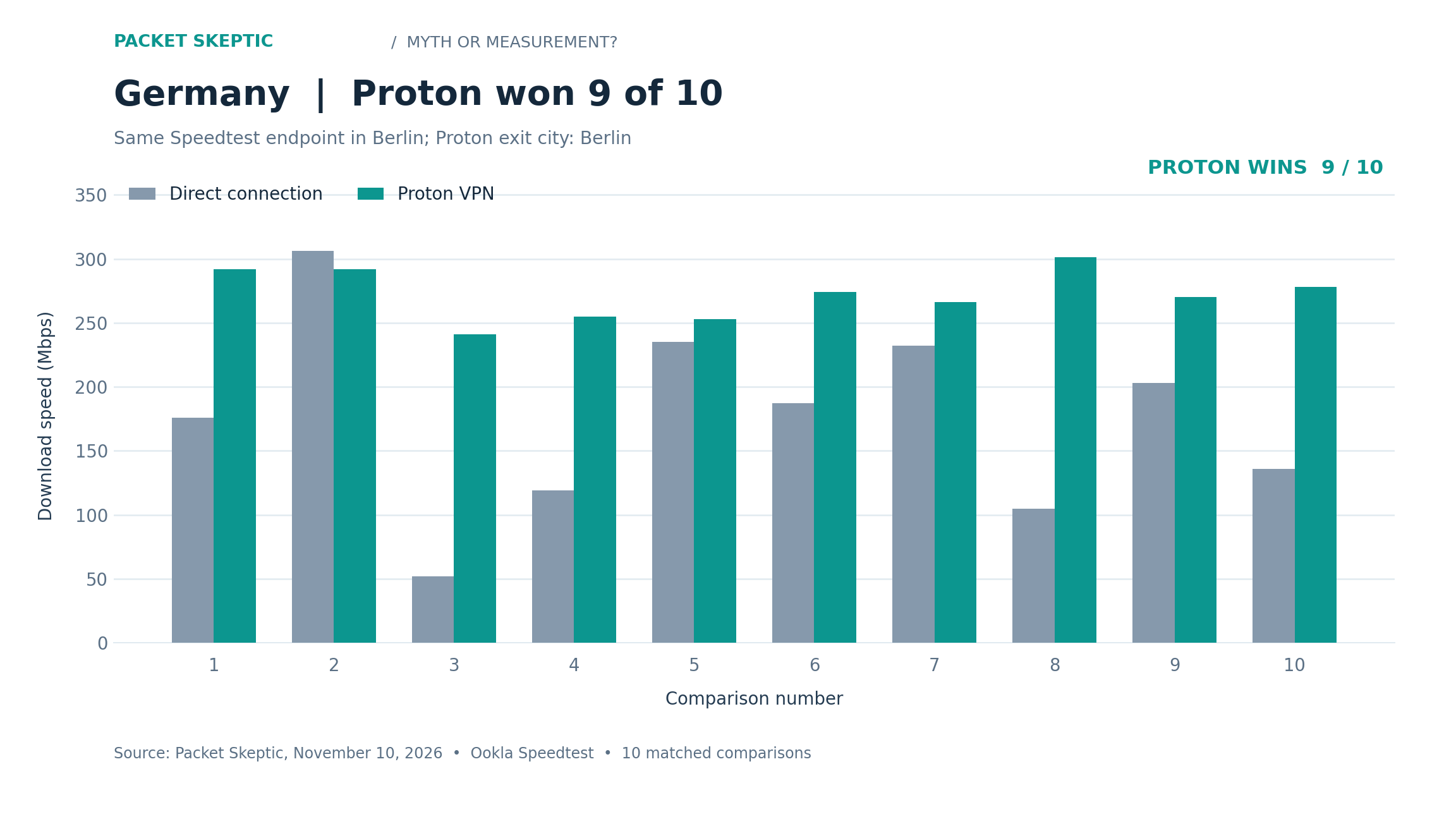
Germany: ten comparisons against the same Speedtest server in Berlin. Teal bars show Proton VPN; slate bars show the direct connection.
The US: now things got really strange
I had considered the possibility of a small improvement when connecting to New York through a VPN.
What actually happened was so far beyond my expectations that the direction of the article began to change as I was running the tests.
Proton won all ten comparisons.
| Connection | Wins |
|---|---|
| Proton VPN | 10 |
| No VPN | 0 |
Without a VPN, Download speeds ranged from 4 to 117 Mbps.
Four.
Four megabits per second!
With Proton, speeds stayed between 209 and 273 Mbps.
In two measurements, the direct connection managed just 4 Mbps. In another, it reached 5 Mbps.
Meanwhile, the VPN was delivering around 240–257 Mbps.
In some comparisons, the difference was more than fiftyfold.
Fifty times!
I hadn't expected anything remotely like this, even in my most optimistic predictions.
Of course, Proton hadn't somehow increased the physical capacity of my internet connection. But data from that particular server in New York really was reaching my computer dramatically faster through the VPN.
My first thought was better routing.
But that explanation alone seemed rather too convenient for results this extreme.
There had to be something else worth looking into.
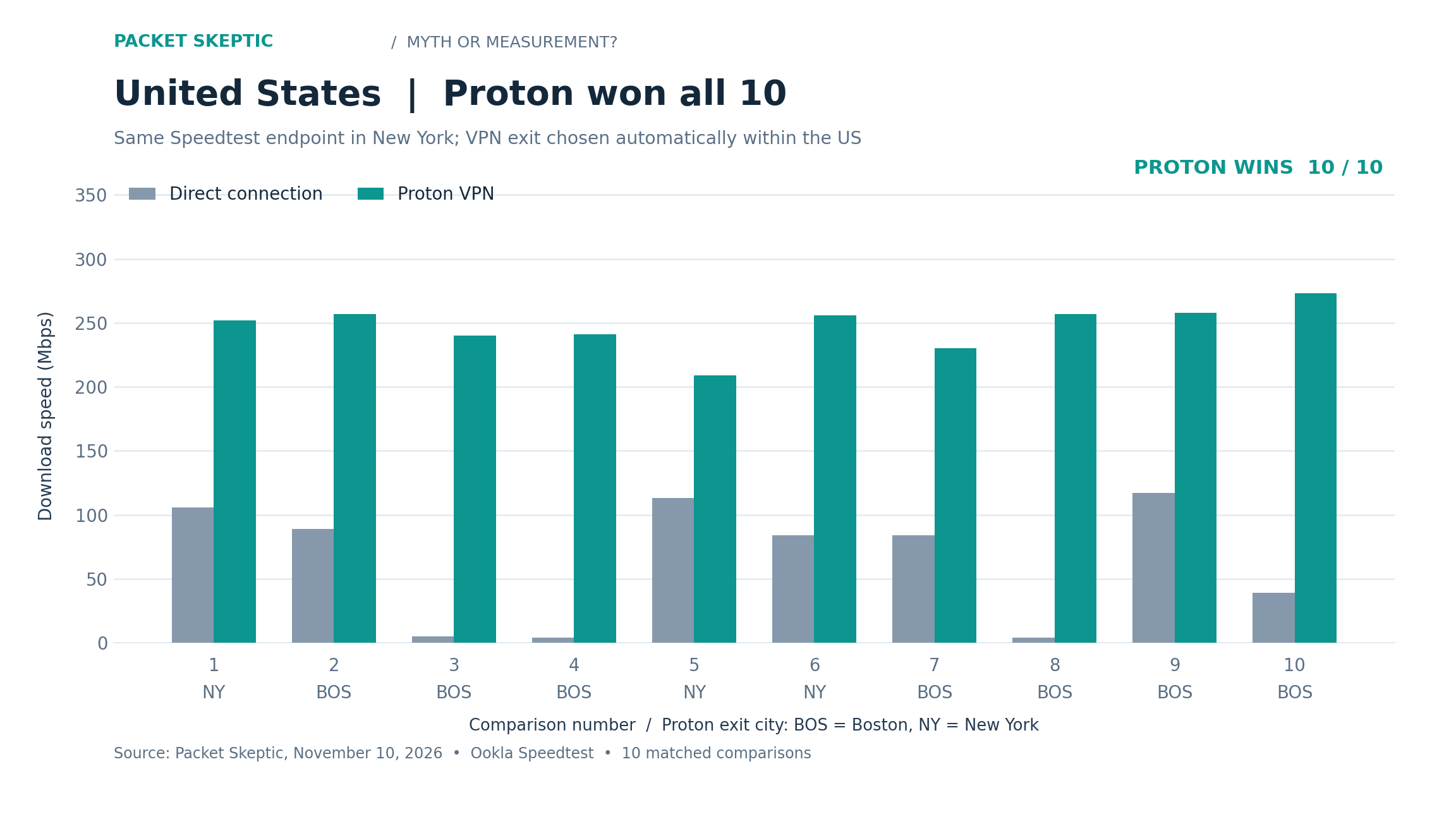
New York: the same Speedtest endpoint for all ten comparisons. BOS and NY mark the Proton exit cities Boston and New York.
What about Upload?
While Download speeds were all over the place, Upload was much less dramatic.
In Germany, the direct connection was faster in all ten Upload comparisons. In the US, it won nine, with one tie.
But the differences were small — generally just a few percent.
That makes for an interesting picture: with Proton enabled, Download speed sometimes increased by dozens of times, while Upload remained practically unchanged.
In other words, the VPN hadn't made every aspect of the connection dramatically faster. The enormous improvement appeared specifically when receiving data.
And that gave me another reason to look more closely at what was happening to Download.
An unexpected suspect: VPN Accelerator
Proton VPN has a feature called VPN Accelerator.
It was enabled throughout the main experiment.
Until then, I hadn't paid much attention to it.
Accelerator. Sounds impressive.
We've all seen plenty of supposedly revolutionary speed boosters. The marketing promises are enormous, while the actual improvement can be so small that you're not entirely sure it's there.
But apparently, not this time.
According to Proton's developers, VPN Accelerator isn't simply a feature that automatically selects a faster server.
It's a collection of technologies designed to make data transmission more efficient.
These include improvements to packet processing, the BBR TCP congestion-control algorithm, and techniques for handling long-distance TCP connections more efficiently.
Proton says the benefits can be particularly noticeable over long distances and under less-than-ideal network conditions.
That sounded suspiciously familiar.
Still, a manufacturer's claims aren't proof. Everyone promises something.
Fortunately, testing this particular feature was remarkably easy.
Turning off VPN Accelerator: what happens?
I kept the US destination and the same Speedtest server in New York.
This time, I ran three rounds of ON/OFF comparisons. In each round, I tested the connection with VPN Accelerator enabled and disabled, switching the setting between the two tests.
Here are the Download results:
| Round | Accelerator ON | Accelerator OFF |
|---|---|---|
| 1 | 305 Mbps | 4 Mbps |
| 2 | 260 Mbps | 10 Mbps |
| 3 | 273 Mbps | 31 Mbps |
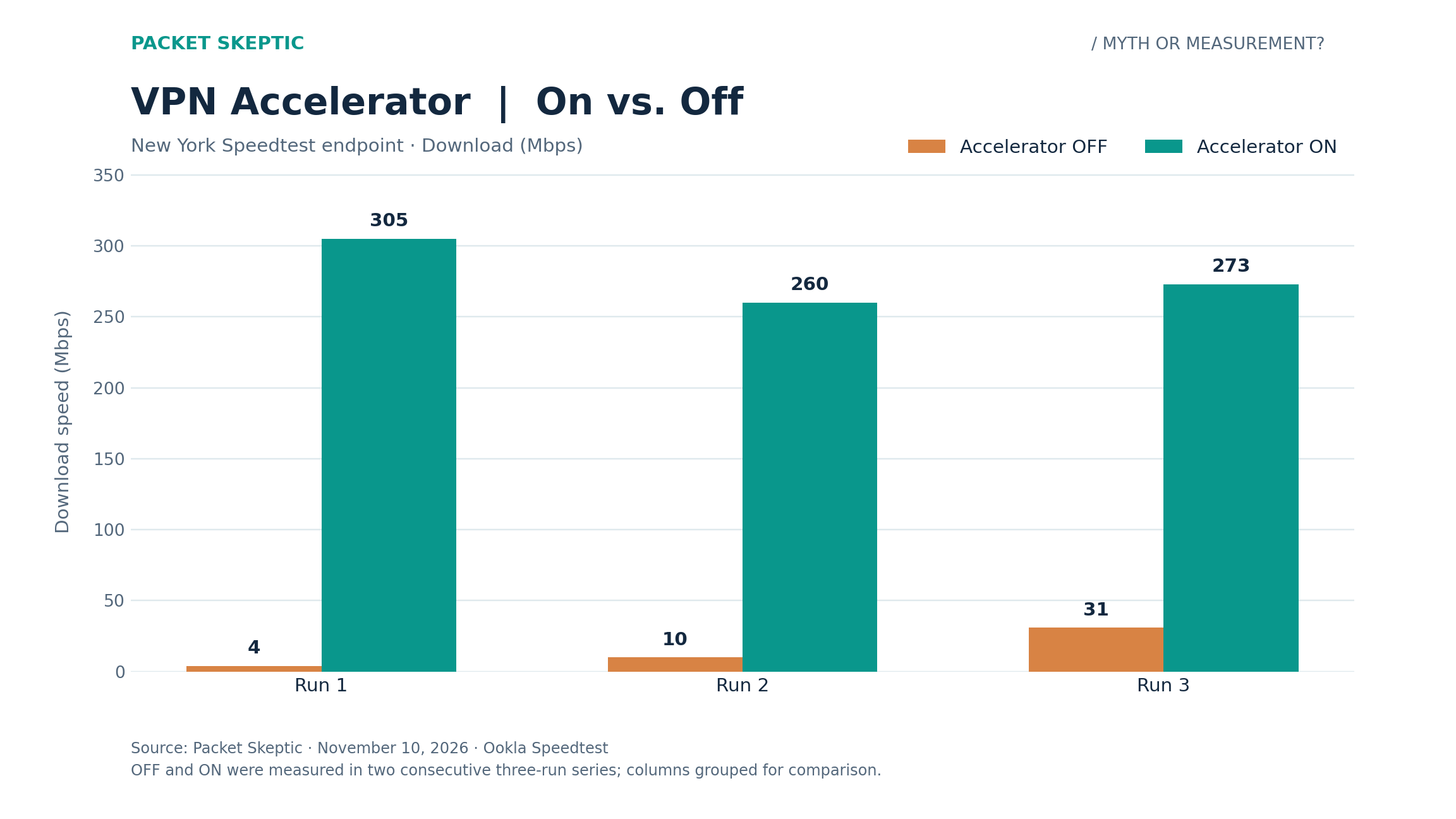
Each pair of bars represents one ON/OFF comparison round, not two separate batches of tests.
With Accelerator disabled, Download speeds were just 4, 10, and 31 Mbps — remarkably similar to some of the worst direct-connection results I'd seen earlier.
With Accelerator enabled, they reached 305, 260, and 273 Mbps.
The contrast appeared in all three rounds. That was a pretty convincing indication that VPN Accelerator wasn't just a marketing gimmick.
At that point, I wanted an even clearer demonstration — something I could actually show readers.
One continuous recording
I started a screen recording and ran another comparison, this time without stopping the video.
First, a Speedtest with VPN Accelerator enabled.
Download: 246.12 Mbps.
Then I opened Proton's settings, disabled VPN Accelerator, and repeated the test against the same Speedtest server.
Download: 30.77 Mbps.
That's roughly an eightfold difference.
And the entire sequence is visible in one recording: the first result, the settings change, and the second result.
No clips stitched together from different days. No collection of carefully selected screenshots.
Taken together with the earlier measurements, this recording provides convincing evidence that VPN Accelerator had a major effect on Download performance under our test conditions.
And that turned out to be the biggest discovery of the experiment.
What does VPN Accelerator actually do?
So how is something like this even possible?
A connection can have plenty of available bandwidth and still deliver disappointing speeds.
That's especially true when TCP is involved and data has to travel over long distances.
TCP provides reliable data delivery. It uses acknowledgments, controls how much data can be in transit, and adjusts its sending rate in response to signs of network congestion.
When latency is high or packets are lost, TCP performance can suffer dramatically.
And that doesn't necessarily mean the physical network link is overloaded.
Sometimes the way data transmission is being managed prevents a connection from making effective use of the bandwidth that's available.
This is where congestion-control algorithms such as BBR can help. BBR estimates available bandwidth and round-trip time to determine an efficient sending rate.
But Proton doesn't rely on BBR alone.
According to the company's technical explanation, VPN Accelerator also improves packet-processing efficiency and uses mechanisms that can break up long TCP paths into shorter segments.
The basic idea is that several shorter, more efficiently managed segments can sometimes deliver better overall performance than one long, poorly performing connection.
That means additional infrastructure doesn't necessarily just add overhead. Under the right conditions, it can help the connection use the network more effectively.
Suddenly, the enormous differences in our results don't seem quite so mysterious.
VPN Accelerator combines several different technologies, though. Our measurements don't tell us which individual mechanism contributed the most.
What they do show very clearly is the effect of enabling and disabling the feature as a whole.
For a more technical explanation of how it works, see Proton's own article about VPN Accelerator.
Does the VPN server's city matter?
I also recorded which city Proton selected for each connection.
That gave me another interesting question to explore: would connecting through different cities produce noticeably different results?
For Germany, all ten connections were through Berlin.
They weren't necessarily all on the same server, though. I definitely saw at least two different Proton servers, but I didn't record their individual identifiers.
In the US, the results were more varied: seven connections went through Boston and three through New York.
Both cities delivered high Download speeds with Accelerator enabled.
Neither showed a clear advantage over the other in the recorded results.
Of course, ten measurements split between two cities aren't enough to declare them equally fast under all conditions.
But there was one useful practical observation: I didn't need to hunt for a special Proton server in the US to get good Download speeds.
Selecting the country and letting the app choose the server was enough in this experiment.
Does this mean a VPN will speed up everyone's internet?
No. That would be a much bigger claim than our results support.
The numbers are certainly impressive, but they come from one home internet connection, two specific Speedtest servers, and Proton VPN with Accelerator enabled.
Someone testing from a different network could see a completely different picture.
If a direct connection is already making efficient use of its available bandwidth, a VPN may offer no improvement at all. The additional processing and altered routing can still make things slower.
And Speedtest results don't automatically translate into the performance of every application. Higher Download speed doesn't necessarily mean lower latency in games or smoother video calls.
None of that makes what we observed any less interesting.
What I learned
I started with a fairly simple assumption: in the vast majority of cases, using a VPN should make an internet connection a little slower.
I knew that better routing might occasionally compensate for the extra overhead, particularly over long distances.
I expected roughly similar results in Germany and perhaps a modest advantage for the VPN in the US.
Instead, Proton won nine out of ten Download comparisons in Germany and all ten in the US.
Then I discovered that disabling VPN Accelerator caused Download speeds in the American tests to collapse, while enabling it again brought the high speeds back.
This wasn't quite the experiment I had expected to end up with.
And perhaps that's the best part.
I set out to test one assumption and discovered something much more interesting along the way.
Adding another server to the path doesn't necessarily make data transfer slower. Sometimes the infrastructure in between can make a connection so much more efficient that the gains far outweigh the additional overhead.
And if I'd stopped after a couple of random Speedtest runs, I probably never would have discovered it.
Test data and reproducibility
The experiment was conducted on November 10, 2026, using a home internet connection, a paid Proton VPN subscription, and Ookla Speedtest.
The main series consisted of 40 Download and Upload measurements — ten comparisons with and without a VPN for Germany and ten for the US.
I also ran three ON/OFF comparison rounds, switching VPN Accelerator between measurements, and recorded a continuous demonstration of turning the feature off.
Packet Skeptic — Myth or Measurement?
Was this article helpful?
Found a factual error?
Technical accuracy matters. Tell us what appears incorrect, and we will review it.